800G OSFP transceiver (DR8/2xFR4/SR8)
800G OSFP 光模块 · Optics & cabling
What Qing asks
One dense message. Five is the whole budget per supplier reply, so the questions that decide comparability go first.
No category-specific question set yet — only the universal commercial terms below.
这批货是全新原封、官翻、拆机件还是工程样片(ES/QS)?请在形式发票上写明状态。如果是拆机件,来源和使用时长是多少?
报价是EXW、FOB还是CIF?指定口岸是哪里?报价里不含哪些费用(出口报关、内陆运输、保险、目的港费用)?
外箱尺寸多少?每箱装几台、毛重多少公斤?每托盘几箱?整单总体积多少立方米?是木托还是纸托、是否需要熏蒸证明?
请给出阶梯报价:1台、10台、50台、100台各是什么价格?每个型号的起订量是多少?价格有效期多久?
出口报关准备用哪个HS编码?报价是含税价还是不含税价?该编码的出口退税率是多少、退税是否已经体现在报价里?
整机原产地写哪里?能否出具原产地证(一般CO还是Form E/RCEP优惠证)?货物是从中国直接出口,还是经香港、新加坡或越南转运?
质保多少个月?DOA(到货即损)申报期限是几天?返修是寄回中国还是有海外备件?是否提供先行换货?返修运费谁承担?
这个托架/导轨/面板是原厂件还是兼容件?上面有没有原厂LOGO或型号标识?能否书面保证不侵犯第三方商标和专利,并承担相关责任?
整机和关键部件(CPU、加速卡、网卡)的原产地分别是哪里?产品里有没有使用美国原产的芯片、软件或技术?大概占多少比例?能不能配合签署最终用户和最终用途声明、承诺不转运?这个型号以前出口过哪些国家?
合同和发票的签约主体全称是什么?统一社会信用代码是多少?工厂是自有还是代工?母公司或控股股东是谁、持股比例多少?有没有国资或上市公司背景?
请提供公司全称、统一社会信用代码和营业执照复印件。贵司是生产工厂、原厂授权代理还是贸易商?如为工厂,工厂地址在哪里、可否安排验厂或视频验厂?开票主体与收款主体是否为同一家公司?
最小起订量是多少?请给出阶梯报价(如100/500/1000/5000片)。报价有效期多少天?NAND和HDD价格波动时如何调价?是否接受锁价?
+ 37 more universal terms
How buyers get burned here
Category-specific, from research rather than generic advice
- Transceiver vendor lock is a software problem sold as a hardware problem. The compatibility code sits in the module's EEPROM and is read over I2C by the switch, which compares it before bringing the port up. Chinese factories will burn whatever code you name — so 'is this Cisco compatible' is the wrong question; 'can you code each unit to our exact switch model list and bench-verify' is the right one. Quotes without a coding answer are not comparable.
- The same trap applies at both ends of every DAC, ACC, AEC and AOC — each end carries its own EEPROM. A cable between a Cisco leaf and an H3C spine needs asymmetric coding, which most buyers never specify and most quotes never mention.
- The .z sweep makes visual inspection worthless for compliance. BIS created .z paragraphs in 3A001.z, 4A003.z, 4A004.z, 4A005.z, 5A002.z, 5A004.z, 5A992.z, 5D002.z and 5D992.z that capture items purely because they incorporate an IC meeting 3A090/4A090 parameters. Two identical-looking 800G switches, or two SmartNICs in the same chassis, can sit on opposite sides of a licence requirement. Only the internal ASIC/DSP part number resolves it, so the ECCN question must be a hard RFQ field, not a footnote.
- Lane structure is invisible in a part number and fatal in deployment. An 800G module can be 8x100G or 4x200G; a 400G can be 8x50G (QSFP-DD) or 4x100G (QSFP112). If the lane structure does not match the switch SerDes generation, the link never trains and both parties blame the other's hardware.
- MPO-12 versus MPO-16 quietly invalidates entire cable plants. 800G DR8 needs MPO-16; most existing trunking is MPO-12. Combine that with UPC-versus-APC end-face and polarity method A/B/C and you have three independent ways to buy a fibre plant that physically connects and optically fails.
- OSFP flat-top versus finned-top, and OSFP versus OSFP-RHS, are mechanical fit decisions inside the switch cage. Ordering the wrong heatsink profile means modules that will not seat in a switch you have already bought.
- Passive DAC reach collapses as lane rate rises. What worked at 3-5m at 25G/lane is roughly 2m at 100G/lane. Buyers reuse an old length survey, order passive DAC, and discover mid-install that half the runs need ACC or AEC at several times the price and with an added export-classification question.
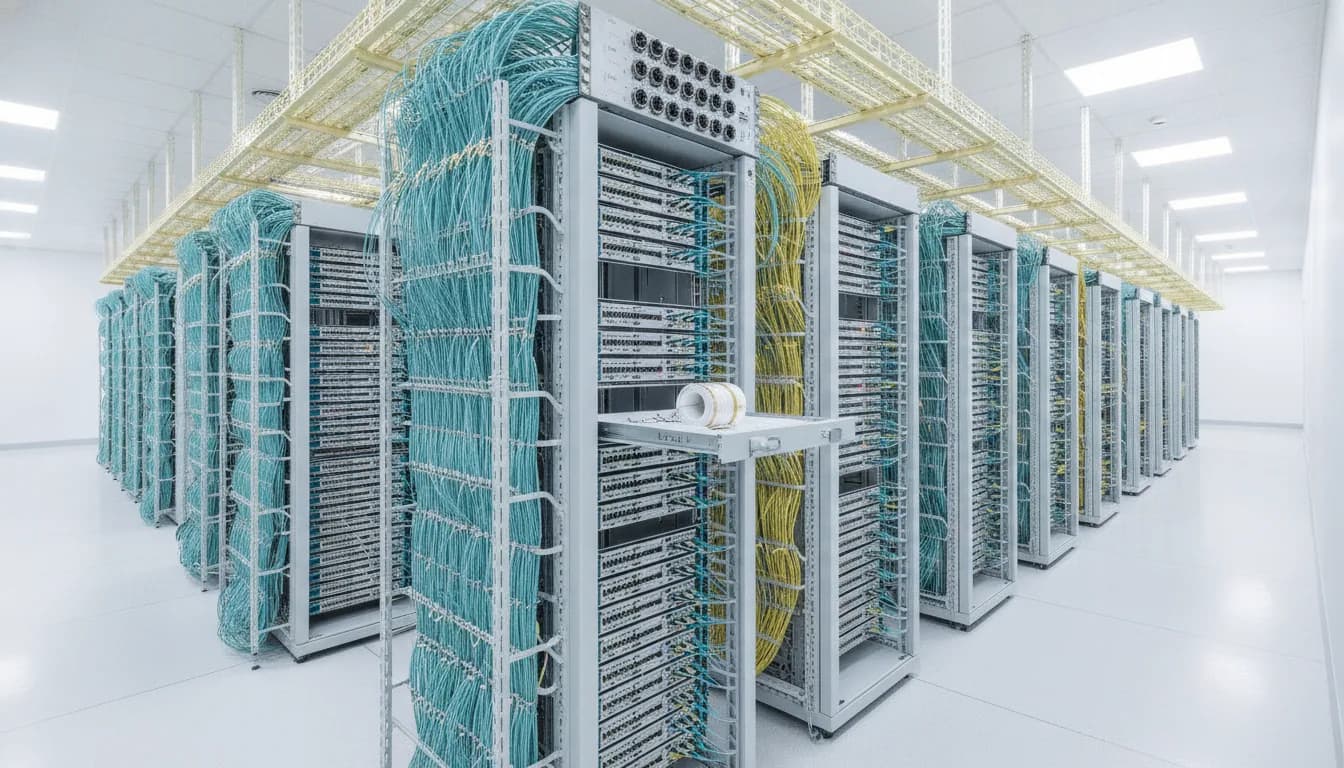
Generated imagery — illustrative of the category, not a photograph of any supplier, facility or product on this platform.